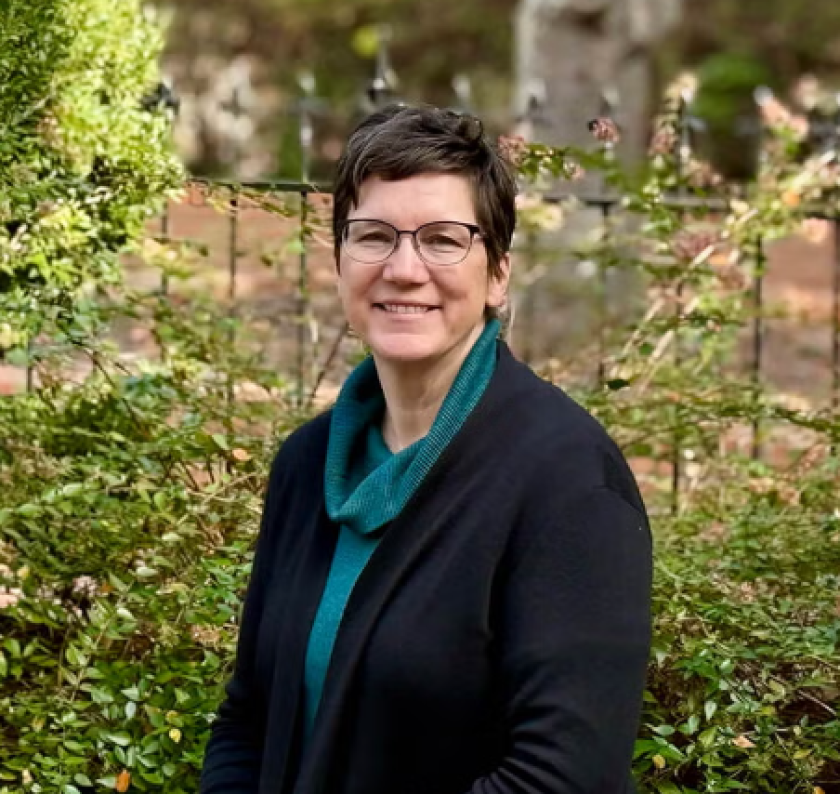
Diane Kelly, the Louis Round Wilson Distinguished Professor in the School of Data and Information Sciences at the University of North Carolina at Chapel Hill, will deliver the 2026 Otlet Lecture on Wednesday, Oct. 7. The lecture will begin at 2 p.m. in Room 126, 501 E. Daniel Street, and on Zoom. A reception will follow. Admission is open to all.
The Otlet Lecture features select scholars who are leaders in the field of library and information science. Endowed jointly by Emeritus Professor W. Boyd Rayward and Eugene Garfield, it honors the career of Paul Otlet (1868-1944), a Belgian lawyer, bibliographer, internationalist, and pacifist who spent his life building experimental "knowledge" institutions that he hoped might facilitate global access to information in a range of new formats.
In her talk, "From Finding Information to Feeding the Machine: A Brief History of Interfaces for Online Information Search Systems," Kelly plans to draw on search interfaces from the past and present to explore the claim that online information search systems have moved through three distinct periods of development.
Although Kelly is widely recognized for her work in interactive information search and user-centered evaluation, she is now concentrating on information and library science history, foundations, and theory. She currently co-leads a project with the UNC-CH University Librarian and the state librarian of North Carolina focused on helping public libraries in North Carolina address AI.
Kelly has received several awards for her research and teaching, including induction into the Association for Computing Machinery’s Special Interest Group in Information Retrieval (ACM SIGIR) Academy, the Association for Information Science & Technology (ASIS&T) Research Award, British Computer Society’s IRSG Karen Spärck Jones Award, BestJASIST Paper of the Decade (2000s) and the ASIS&T/Thomson Reuters Outstanding Information Science Teacher Award. She has served as chair of the ACM SIGIR, co-editor-in-chief of Foundations and Trends in Information Retrieval, and as a member of the American Library Association Committee on Accreditation.