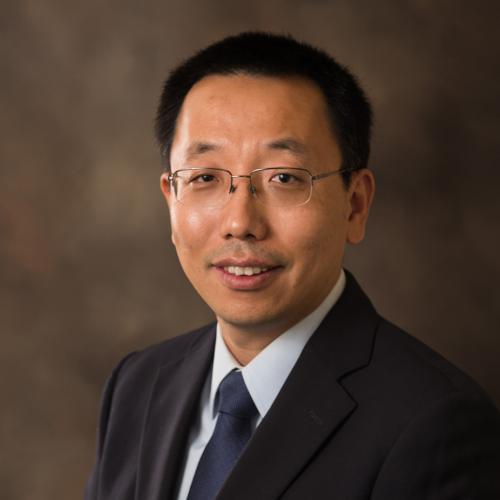
Dong Wang, professor and associate dean for research, has received a grant supporting his work in the areas of social sensing and intelligence and human-centered AI.
Wang is principal investigator on an Amazon-funded project with a team of Amazon researchers, developing a new approach that could help AI better distinguish between requests that require intervention and those that do not.
AI systems are designed to avoid harmful or biased responses. But sometimes those protections can be too broad, causing an AI to reject legitimate questions or lose important context needed to provide a good answer.
"Safety is important, but we also want AI systems to remain useful," Wang said. "The goal is to make AI more aware of context, so it can respond appropriately rather than simply taking the safest-looking path every time."
Consider two questions involving demographic information in health care. One might ask an AI to produce a harmful stereotype about a social group. Another might ask it to analyze differences in health care access among demographic groups. Although the questions involve similar information, they have very different purposes.
The researchers want AI to recognize that difference.
Their approach would assess a request as it is being processed and determine whether an intervention is actually needed. When one is necessary, the researchers will study how to make it as targeted as possible, reducing harmful behavior without unnecessarily interfering with the AI's ability to reason, retrieve information or answer other parts of a question.
The broader goal is to reduce a fundamental tension in AI: making a system safer can sometimes make it less capable or less helpful. Wang and his collaborators hope to develop a system that provides strong protection when risks are high while preserving accuracy and useful reasoning when a request is legitimate.
"People should not have to choose between AI that is safe and AI that is useful," Wang said. "We want to help make both possible."
Another project, on which Wang serves as co-PI, also received funding from the National Science Foundation. Na Wei and Vijay Singh, from Illinois' Grainger College of Engineering, are principal investigator and co-PI, respectively, on "Transforming Biorefinery Waste Streams into Phosphorus Resources through Synthetic Biology-Enabled Biocatalysis."
The conversion of plant material like corn or wood into fuel or other products creates waste byproducts. These byproducts are often high in organic phosphorus, which is a key ingredient in fertilizer. But the form of the phosphorus in this waste, called phytate, is not usable as a plant nutrient. The project, based on a study published in February, seeks to convert phytate to a usable form of phosphorus called phosphate, using an enzyme called phytase.
Wang’s role in the project will be to design and refine an AI method to identify effective phytase variants.
Wang serves as director of the Social Sensing & Intelligence Lab in the iSchool at Illinois.