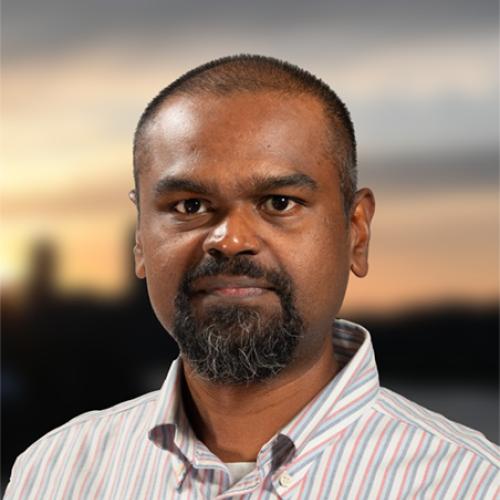
Teaching Assistant Professor Nitin Verma is among the 20 faculty from the University of Illinois System who were selected for the 2026–2027 cohort of the Public Voices Fellowship. The program is part of a national initiative led by The OpEd Project to help experts from underrepresented groups to be positioned as public thought leaders in their fields and contribute to the national dialogue around important issues.
Members of the cohort will attend four sessions during the academic year and will be paired with a journalism mentor for individual editing and coaching, with the goal of publishing two or more op-ed pieces during the program. Those who complete the one-year fellowship will join a national network of peers, allowing for knowledge-sharing and innovation across multiple institutions.
Prior to joining the iSchool, Verma served as one of the inaugural Artificial Intelligence and Society postdoctoral fellows, in a program collaboratively hosted by Arizona State University's School for the Future of Innovation in Society (SFIS) and the New York Academy of Sciences. He obtained his PhD in information science from the School of Information at UT-Austin, where his research was focused on studying trust, misinformation, AI ethics, and human values. Prior to that, he earned an MS in Information Studies at the UT-Austin iSchool. He has taught undergraduates and graduates at both UT-Austin and ASU. He also has nearly a decade of industry experience as a software engineer and programmer.
According to Verma, the ongoing surge in the adoption of generative AI–based tools has upended traditional notions of authorship, trustworthiness, accountability, and transparency in the "uniquely human endeavor" of knowledge production.
"This has occasioned a new set of challenges for knowledge work across practice domains—such as journalism, scholarly peer review, historiography, and archival, to name a few—and across the spectrum of media types including photography/video, text, and audio," he said. "Through my op-eds I hope to bring empirical and philosophical perspectives from my scholarship on these topics to help diverse audiences better comprehend AI's implications and trade-offs for society."