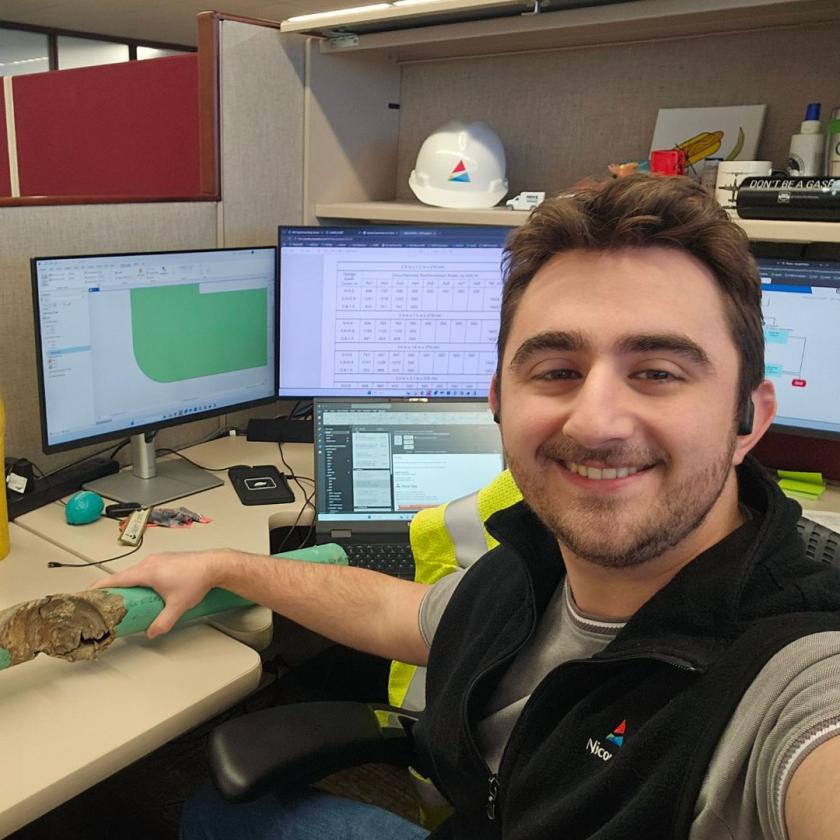
In his role as analyst at Nicor Gas, Eugene Gurevich (BSIS '23) is making sure the natural gas system that millions of people use stays safe and dependable. He credits the iSchool with teaching him technical skills—such as how to clean, transform, and visualize data—as well as how to communicate effectively with different audiences. Gurevich encourages current students to "explore unconventional career paths."
Where do you work and what is your role?
After graduating from the iSchool, I joined Nicor Gas, a natural gas utility company headquartered in Naperville, Illinois. Nicor provides natural gas service to 2.3 million customers across more than 650 communities in northern and central Illinois. I work as an analyst in the Distribution Integrity department, which is responsible for ensuring the safety and reliability of our nearly 34,000 miles of distribution pipelines.
Our department's main focus is risk management by using data-driven insights to predict where potential pipeline issues might occur and identifying ways to prevent them. We rely on a sophisticated risk model that incorporates engineering, environmental, and operational data to evaluate the likelihood and potential consequences of pipeline incidents. Because these consequences are probabilistic, we must consider a range of possible outcomes based on both fixed factors (like pipe size and pressure) and variable ones (such as how quickly a leak is detected or whether an ignition source is present).
In addition to analyzing risk, I also help ensure the company remains compliant with federal and state regulations governing natural gas. My work sits at the intersection of data science, engineering, and public safety. All of these are fields that require careful analysis, collaboration, and communication.
What do you like best about your job?
What I enjoy most about my role is the diversity of work and the opportunity to apply my information science background in so many different ways. No two days are ever the same. Some days I'm deep into data analysis, building and maintaining data pipelines that integrate complex tabular and geospatial data to help us understand what's happening across our system. Other days, I'm out in the field with our crews, investigating potential pipeline issues firsthand and helping guide decisions about how to address them.
I also get to work in project management, overseeing capital pipeline replacement projects and collaborating with engineers to determine the most effective strategies for reducing future risk. This mix of technical analysis, fieldwork, and project leadership keeps me constantly learning and growing. I love that my job allows me to see the full picture, from data models to real-world applications, and that I can contribute to decisions that have a tangible impact on people's safety and comfort.
What do you see as the most important impact of your work?
The most meaningful impact of my work is helping ensure the safety and reliability of the natural gas system that millions of people depend on every day. Our team's efforts directly influence how we maintain and improve infrastructure, prioritize repairs, and prevent incidents before they occur.
There’s a real sense of purpose in knowing that the analyses I conduct and the decisions I help guide contribute to keeping both employees and customers safe. Natural gas plays a critical role in heating homes, powering businesses, and supporting communities, and the work we do helps sustain that reliability. It's rewarding to see how data-driven insights can translate into safer operations and better service for our customers. Every time I see a project completed or a risk mitigated, I'm reminded of why this work matters.
How did the iSchool at Illinois help you get to where you are today?
The iSchool provided the foundation I needed to succeed in a data-driven but interdisciplinary role. Courses in data analytics and data science taught me how to approach problems systematically; how to clean, transform, and visualize data; and how to apply machine learning algorithms to uncover patterns and insights. Those technical skills have been essential in building and maintaining the risk model that underpins much of my department's work.
Beyond the technical side, the iSchool also taught me how to communicate effectively with different audiences. IS 419 [Entrepreneurial Information Technology Design], for example, emphasized the importance of tailoring your message depending on who you're speaking to. In my case, it can be field mechanics, engineers, or executives. That ability to translate complex data into clear, actionable information has been one of the most valuable skills I use every day.
Even courses that seemed less directly related to my current field, like those focused on librarianship and information organization, have proven relevant. I often have to dig through historical records and archives to understand how our system has evolved, and the research and information retrieval skills I learned at the iSchool have been instrumental in that work. The program really prepared me to think critically about how information is created, stored, and used, no matter the industry.
What advice would you like to share with iSchool students?
My biggest piece of advice is don't be afraid to explore unconventional career paths. It's easy to assume that an information sciences degree has to lead to a job in tech or data analytics at a big-name company, but the truth is that information professionals are needed everywhere. Utilities, healthcare, government, manufacturing . . . these industries all rely on data and information management to operate efficiently and safely.
Working in a company like Nicor Gas has shown me how powerful information science skills can be outside of the traditional tech environment. I've been able to drive meaningful change and innovation by applying what I learned at the iSchool, whether that's building and improving risk modeling methodology, or enhancing communication between technical and non-technical teams.
My role has also allowed me to develop a broad range of skills: data science, data engineering, GIS, engineering analysis, project management, and leadership. These experiences have given me a holistic understanding of how information connects every part of an organization. So, keep an open mind, be curious, and don’t hesitate to apply your knowledge in unexpected places . . . you might find your most rewarding opportunities where you least expect them.
What do you enjoy doing in your spare time?
Lately, I've really gotten into barbecuing. I recently bought a house, and one of my first purchases was a grill and smoker. I've been experimenting with different techniques and recipes, learning how subtle changes in temperature, wood type, or timing can completely transform the flavor of the meat. It's a fun and rewarding hobby because it combines patience, precision, and creativity. There's something satisfying about putting in the effort and seeing (and tasting!) the results pay off.
Outside of barbecuing, I enjoy biking and exploring the local state parks with my girlfriend or playing pickleball with friends. Getting outdoors helps me recharge and appreciate the natural landscapes that are all around our state.
I also spend a lot of time with my cat, who I adopted from the Champaign County Humane Society while I was an undergraduate. She sat through all my iSchool classes with me, and now she keeps me company while I'm analyzing pipeline data. She's become my "Director of Snacks and Supervisory Naps" while she's been part of my journey from student life to professional life.