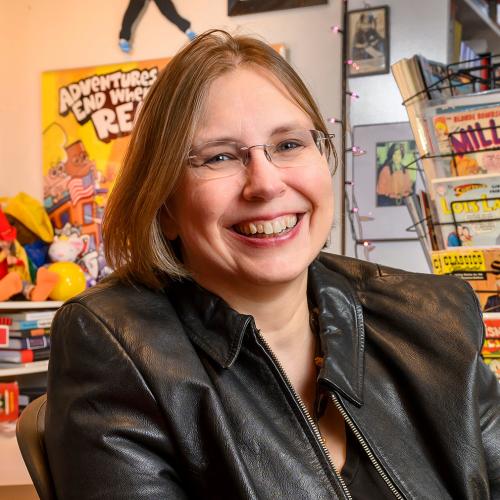
The year’s best comics and graphic novels will be honored with Will Eisner Comic Industry Awards in July at Comic-Con International in San Diego. Carol Tilley, a University of Illinois associate professor of library and information science, is one of six judges selecting the comics that will appear on the awards ballot in more than two dozen categories. The judges are meeting this week (April 7-11) in San Diego to discuss their choices and finalize the ballot. Tilley conducts research on comics readership, and she debunked the data used by a 1950s anti-comics-crusading psychiatrist. She talked with News Bureau arts and humanities editor Jodi Heckel about the role of an Eisner judge and what trends she is seeing in comic books.
What comics are eligible for the awards, and how do they get submitted?
Essentially any comic or book about comics published in 2015 is eligible for consideration. Publishers and creators have the option of submitting titles to the Eisner Awards’ administrator but, in reality, the judges are looking not only at what’s submitted, but well beyond that to ensure that we’re nominating the best possible comics in each of the more than thirty ballot categories.
Lots of people equate comics with superheroes, but there’s a tremendous breadth and depth in contemporary comics publishing. Consequently, I’m reading everything from fantasy and science fiction comic books to kids’ graphic novels, long-form memoirs in comics form to multicreator anthologies, webcomics to scholarly monographs about comics, and more. And, of course, I’m reading plenty of superhero titles, too.
What is the significance of winning an Eisner Award? Of being an Eisner judge?
Each year, six individuals are selected to be Eisner judges. The jury is balanced so that each year at least one person serving on it is a comics scholar; this year, I’m that person. It’s an extraordinary honor and opportunity to help recognize the best comics and creators for the preceding year.
To win or even be nominated for an Eisner, especially if you’re working outside one of the major comics publishers like DC and Marvel, can be a significant career boost. You’re always going to be able to say “Eisner-nominated” or “Eisner-winning” in conjunction with your name. It can also lead to a sales boost, especially in terms of library sales, since listed titles often have greater visibility and demand.
What do you look for in deciding which are the best comics from the past year?
I’m looking for comics that tell good stories. That means the words, the pictures, the design, the whole comics package has to work in concert to grab readers. At the same time, I’m not the intended reader for all of the comics that will be under consideration this year, so there are times when I have to step outside of myself and my biases to ensure that I’m giving all titles their fair consideration.
Are there any trends you have seen recently in comic books?
In contemporary comics, there’s something for virtually any reader, young or not-so-young. You can find powerful memoirs about aging, death, and illness, like Roz Chast’s Can’t We Talk about Something More Pleasant?, Tom Hart’s Rosalie Lightning, and Jennifer Hayden’s The Story of My Tits, respectively. You can find adventure stories with strong girl characters, like Jeremy Whitley’s Princeless, Noelle Stevenson’s Nimona, or Ben Hatke’s Little Robot. African-American history? Joel Christian Gill’s Strange Fruit comes to mind. An AI-themed space opera? Try Jeff Lemire and Dustin Nguyen’s Descender. Grisly dystopian horror? Josh Simmons’ Black River. A humorous guide to how your body works? Human Body Theater by Maris Wicks. And these are just a few North American titles published by conventional presses. Start looking at the minicomics, webcomics, and international (both English-translated markets and others) titles, and the range of what’s available becomes even more staggering. With respect to diversity, comics still has room to grow, as does the rest of the publishing and entertainment industry, but the signs of change are clearly visible.
How does being an Eisner judge fit with your faculty role at the U. of I.?
At Illinois, I’m fortunate enough to be able to combine my passion as a lifelong comics reader with researching comics history, as well as teaching comics-related courses for librarians. Serving as an Eisner judge is recognition for my scholarly contributions, but it also allows me to consider the industry from new perspectives, read even more comics, and meet some fascinating folks. Already my experiences as an Eisner judge are finding their way into conversations with students.

At GSLIS, Tilley teaches courses in comics reader’s advisory, media literacy, and youth services librarianship. Part of her scholarship focuses on the intersection of young people, comics, and libraries, particularly in the United States during the mid-twentieth century. Her research has been published in journals including the Journal of the Association for Information Science and Technology (JASIST), Information & Culture: A Journal of History, and Children’s Literature in Education. Her research on anti-comics advocate Fredric Wertham was featured in the New York Times and other media outlets.