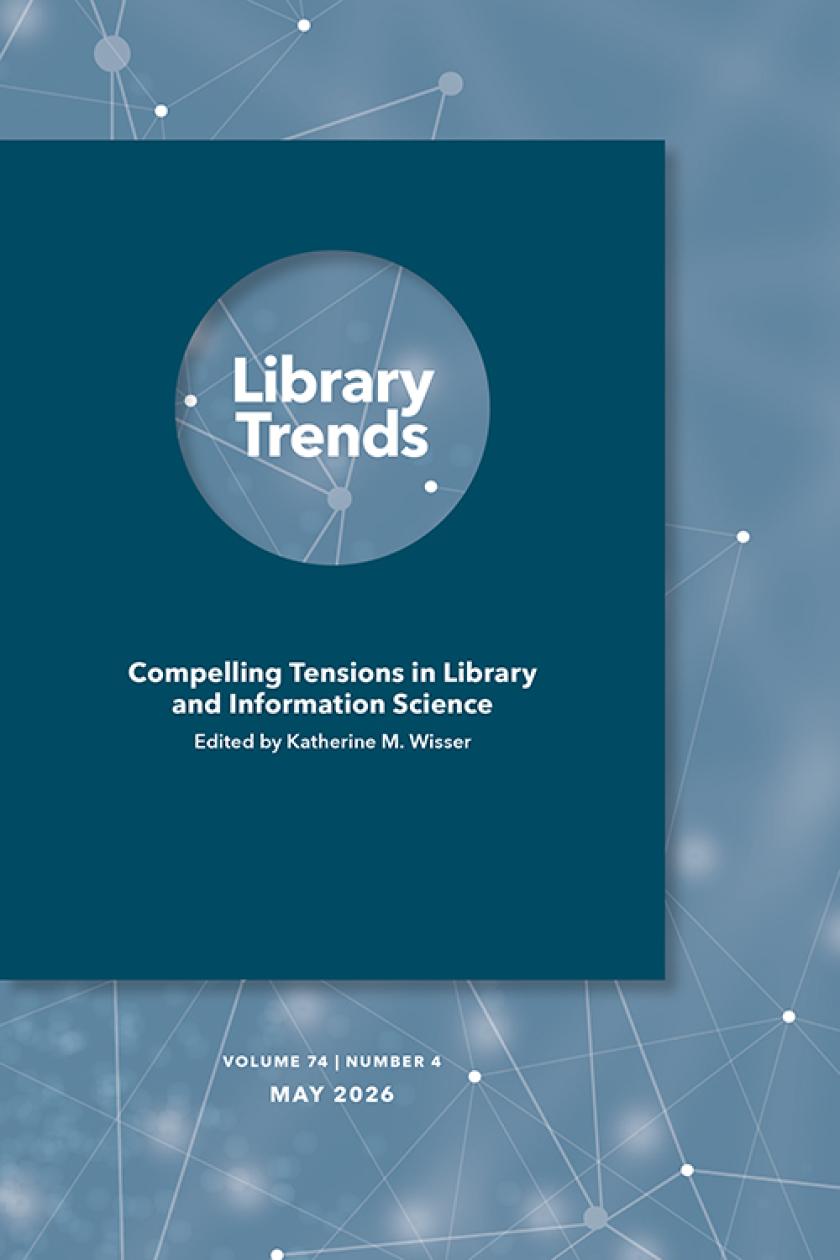
The iSchool at Illinois is pleased to announce the publication of Library Trends 74 (4) "Compelling Tensions in Library and Information Science."
In The Structure of Scientific Revolutions, Thomas Kuhn posited that paradigm shifts are driven by periods of revolution, rather than incremental, progressive change. For "Compelling Tensions," guest editor Katherine M. Wisser challenged authors to identify and explore contemporary disciplinary tensions that could lead to paradigm shifts in the LIS field.
The result is a collection of articles addressing a wide range of LIS topics, from conceptions of neutrality, to support for protest media, to epistemic justice and linked data, to memory work for public tragedies. Authors invite readers to consider how the LIS field is changing and how the tensions wrought by these changes could (or should) lead to a revolution of ideas and drive changes in the field.
This issue is published with open access.
Library Trends will host a webinar with Wisser and select authors in the Fall 2026 semester.
The table of contents includes:
- "Introduction: Compelling Tensions in Library and Information Science" by Katherine M. Wisser
- "Shifting Politics of Openness and Regulation: Queer Theory, Protest Media, and Podcasting Initiatives" by Heejoung Shin
- "Epistemic Justice and Linked Data: Balancing Global Interoperability and Community Knowledge" by Julaine Clunis
- "Intellectual Freedom in Carceral Spaces: Exploring Tensions in Abolitionist Librarianship" by sam hidde tripp and Sarah McDaniel
- "Struggling with Neutrality: Wikipedia and Library and Information Science Professionals in an Eastern European Postsocialist Cultural Context – A Case Study" by Claudia Șerbănuță and Bogdan Vătavu
- "Skeptically Defining the "Post-Reference Epoch'" by Christina Norton, Jennifer A. W. Stubbs, Annie Sollinger, and Tim Ribaric
- "When is Critical AI Literacy Critical? Critical AI Literacy Discourse and Principles of Critical Pedagogy" by Andrea Baer
- "Artificial Intelligence, Authentic Reactions: Tensions Between Digital Libraries and Generative AI" by Shelley E. Barba, Matthew McEniry, Megan Scott, and Heidi M. Winkler
- "Remembering Now to Forget Later: Trauma, Archives, and the Tension of Commemoration" by Bradley J. Wiles
Library Trends is an essential tool for professional librarians and educators alike. Each issue explores critical trends in professional librarianship and includes practical applications, thorough analyses, and literature reviews. The journal is published quarterly for the School of Information Sciences by Johns Hopkins University Press. Subscriptions to current issues are available both online and in print.
Back issues (1952 through two years prior to the current issue) are available online through IDEALS, the digital repository for scholarly work produced at the University of Illinois Urbana-Champaign.
Please send ideas, inquiries, or issue proposals via email to Melissa Wong, editor in chief, at librarytrends@illinois.edu.