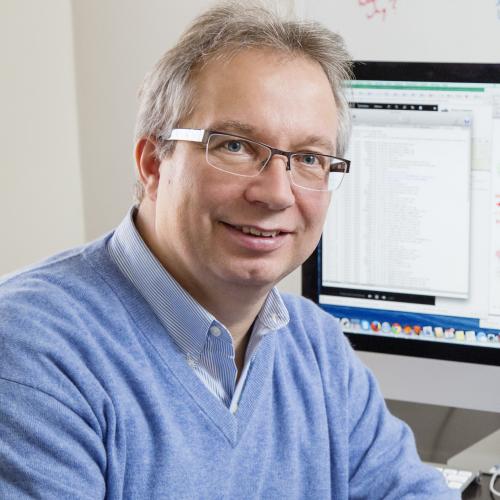
GSLIS is pleased to announce that Professor Bertram Ludäscher will join the GSLIS faculty in Fall 2014.
Ludäscher is a leading figure in data and knowledge management, focusing on the modeling, design, and optimization of scientific workflows, provenance, data integration, and knowledge representation. He is one of the founders of the open source Kepler scientific workflow system project, and a co-lead of the DataONE Working Group on Provenance in Scientific Workflows. DataONE (Data Observation Network for Earth) is one of the initial NSF-funded DataNets and develops a distributed framework and cyberinfrastructure for environmental science data.
Ludäscher is also developing workflow technology for quality control and data curation, e.g., of biodiversity data in natural history collections. He is leading the NSF-funded Euler project, where he is developing logic-based methods for the alignment and merging of biological taxonomies.
At Illinois, Ludäscher will also have an appointment at the National Center for Supercomputing Applications (NCSA) and an affiliate appointment at the Department of Computer Science.
“This is an exciting time for the computer and information sciences: Everybody talks about ‘big data,’ and the market for data scientists is burgeoning. But with all the excitement about the new challenges and opportunities in data analytics, we must also continue to improve our capabilities to organize and curate data,” said Ludäscher. “To get valuable insights out of data at the end of analysis pipelines, we need to invest in the modeling, management, and curation of data further upstream. I’m excited to join the iSchool at Illinois, which has been the leader in information science research and education, emphasizing the importance of all phases of the data lifecycle. I’m also looking forward to collaborating with NCSA and working with colleagues in computer science on the many new challenges and opportunities in data science.”
“We are delighted to have attracted one of the world's leaders in scientific data management to GSLIS,” said Dean Allen Renear. “Digital technologies have created exciting new opportunities to analyze vast quantities of diverse data, advancing science and addressing major societal problems—but supporting the use of this information presents deep challenges. For many years now Bertram has been leading the way in meeting these challenges.”
“NCSA is a nexus of big data, both from the Blue Waters petascale supercomputer and from massive observational projects like the Large Synoptic Survey Telescope. There are many issues involved in making meaning from—and finding, publishing, sharing, and archiving—these data,” said NCSA Director Ed Seidel. “We look forward to working with Professor Ludäscher and benefitting from his knowledge and expertise as we tackle these challenges together.”
Ludäscher was most recently a professor at the Department of Computer Science and the Genome Center at the University of California, Davis. Prior to joining UC Davis, he worked at the San Diego Supercomputer Center at UC San Diego where until 2004 he was an associate research scientist, leading the Knowledge-Based Information Systems Lab.
He received his MS in computer science from the Technical University of Karlsruhe in 1992, and his PhD in computer science from the University of Freiburg in 1998.