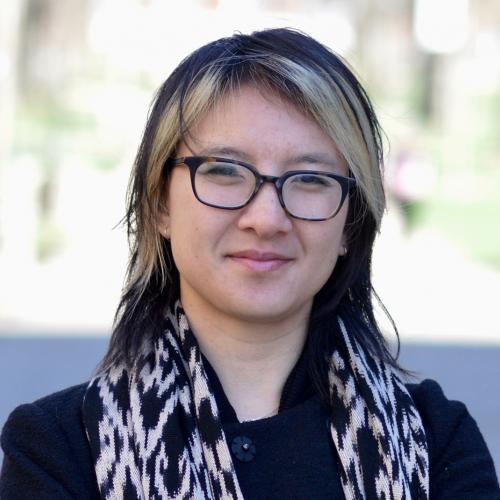
The Community Data Clinic, a mixed methods data studies and interdisciplinary community research lab led by Associate Professor Anita Say Chan, is partnering with the Cunningham Township Supervisor's Office, one of the primary social services agencies in Champaign County, to help vulnerable populations and families in crisis. Their partnership will result in a research project to inform a new online version of the 211 directory that connects people, based on locality, to dozens of crisis response and social services, including housing, mental health services, and food support. Funded by the United Way of Champaign County and Champaign County Mental Health Board, with a call center run by PATH in Bloomington, Illinois, 211—a service available 24 hours a day, 7 days a week, 365 days a year—provides information and referrals to 44 counties in the state, all at no cost and with anonymity to users.
More than a third of Illinois families are unable to cover a basic survival budget, and data show 26.9% of Champaign residents living in poverty and 31.9% of Urbana residents in poverty. With the COVID-19 pandemic turning many lives upside down, the need for access to social services resources has reached a critical level, with 211 alone seeing a 41% increase in call volume at the end of March compared to data from one year before.
"Organizations like Cunningham Township have let us know that their general assistance/welfare rolls have swelled by three hundred percent since the pandemic started, and they are receiving nonstop phone calls about people needing rental assistance," said Chan.
The Community Data Clinic brings together an interdisciplinary team of faculty, community organizers, and leadership from organizations like Cunningham Township Supervisor's Office, which dedicates research to extend public service and outreach, while bridging disciplinary expertise and training across social sciences, computer science, engineering, arts and humanities. The clinic hosts graduate research assistants as well as classes and research communities that extend training on community data and research methods. Jorge Rojas and Adrian Wong, PhD students in the Institute of Communications Research at Illinois, lend research support and assistance as the graduate RAs of the 211 collaboration.
According to Danielle Chynoweth, Cunningham Township supervisor, information resources for social service provision in Champaign County are key to addressing gaps in support. While 211 has helped by providing important services, including live phone operators and a call center, enhancing online functionality would give a significant boost to accessibility for people in need, case workers, and service providers.
"Efficient and effective information access and data-driven decision making routinely impact life or death situations," said Chynoweth. "Real-life scenarios are preventable with better information distribution. For example, a family in need spends precious time and resources to travel to a food pantry, only to find that it recently closed; or a new law provides free childcare for the homeless, but those in need can't access the necessary information. These deceptively simple problems are only instances of a pervasive issue that requires a holistic approach."
The project will enhance the design of the user interface of existing service directories, such as 211 and other resource guides, and will decrease the number of steps users need to access accurate information. With a collaboration that also draws upon the expertise and leadership of other civic organizations, including the United Way of Champaign County and Champaign County Mental Health Board, the team aims to undertake research to inform how design can be tailored and oriented to meet needs of vulnerable populations and communities.
"211 represents an important case for studying the diverse work of community agencies in the development of sociotechnical systems in civic and public sectors, and the relevance of users in providing feedback over time when developing accountable information services," said Rojas. "We need to elevate the leadership and strengthen the social networks serving these populations."
Chan holds a joint appointment with the College of Media, where she is an associate professor in the Department of Media and Cinema Studies and directs the interdisciplinary Technocultures Lab. She holds a Fiddler Innovation Faculty Fellowship at the National Center for Supercomputing Applications and is a faculty affiliate at the Illinois Informatics Institute, Unit for Criticism and Interpretive Theory, Center for Latin American and Caribbean Studies, Center for Global Studies, Department of Anthropology, and Department of Asian American Studies. Chan received her PhD from MIT in the history and anthropology of science and technology studies (STS).