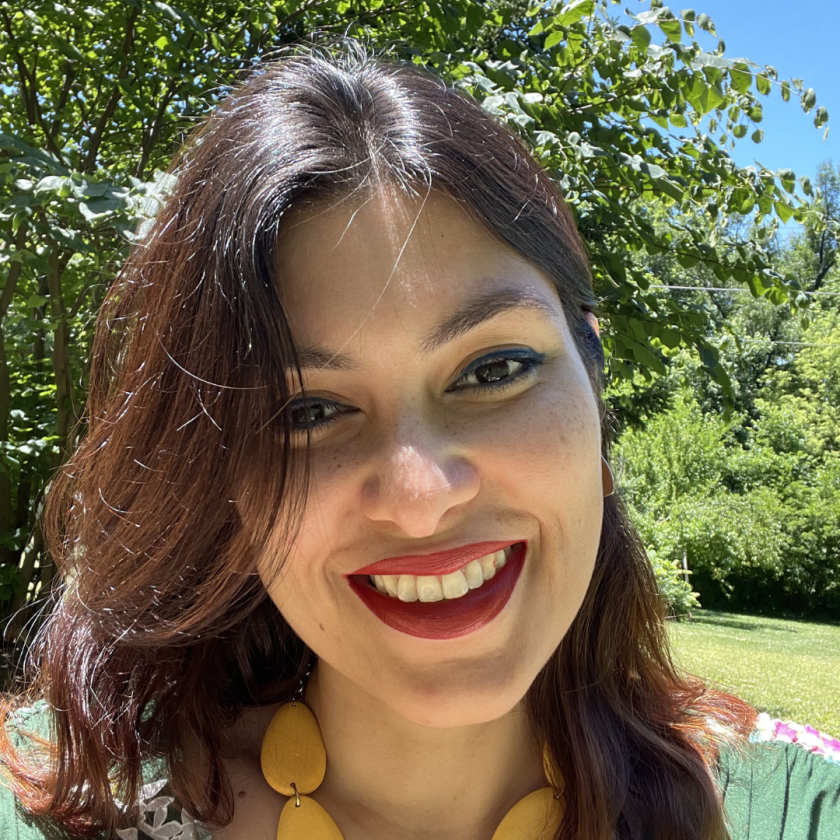
Thirteen iSchool master's students were named 2022-2023 Spectrum Scholars by the American Library Association (ALA) Office for Diversity, Literacy, and Outreach Services. This "Spectrum Scholar Spotlight" series highlights the School's scholars. Daynali Flores-Rodriguez holds an MA and PhD in comparative and world literature from the University of Illinois Urbana-Champaign and BA in comparative literature from the University of Puerto Rico.
Why did you decide to pursue an LIS degree?
As an educator and first-generation college student, my work and personal experiences have always been close to vulnerable and underserved groups. I know that belonging and inclusion go hand in hand with civic engagement and advocacy. The lack of appropriate information and resources prevents people from participating effectively in civil society and is one of the reasons why many communities remain disenfranchised. I want to advance my research and information skills to help the broader community, whether in a public library, government agency, or nonprofit organization. An LIS degree will provide me with practical tools to help create pathways of information and resources that remain inaccessible to many. I also harbor the hope that someday I will be instrumental in bringing more public libraries—like the ones I enjoy on the mainland—to rural areas in Puerto Rico.
Why did you choose the iSchool at Illinois?
The University of Illinois was the first institution in the continental United States that believed in my potential as a graduate student and was willing to invest in my education when I first applied more than twenty years ago. I kept close ties with the people I met at Illinois, and I knew about the iSchool's reputation as the best school in the nation for library and information science. On the practical side, when I applied to the iSchool, I lived a mere 45 minutes away, and I thought it would be neat to be able to take courses in person from time to time.
What LIS topics interest you most?
I am still exploring and learning, but one fascinating aspect of the LIS field is the many possibilities ahead of me. At this moment in my life, I want to develop practical skills that will allow me to bypass systemic and institutional barriers that prevent people from achieving their full potential. I want to learn how to build networks of information; identify and address the information needs of underserved communities; increase civic engagement among different constituents; and understand, design, and implement human-centered technologies and strategies that facilitate effective social alliances for the common good. Every course I have taken so far has addressed (at least partially) some of these concerns. I feel as if I am slowly solving a puzzle.
What do you do outside of class?
After relocating to Panama City, Florida, with the Air Force last October, I have kept busy trying to settle my family in our new surroundings. I am still exploring all the beaches, soaking in the sun as much as possible, and trying to find my way around without relying too much on my GPS. I enjoy reading for pleasure, and this year, my goal is to finish reading my own library before getting more books (so far, I am reading my books, but I’m still adding more to the collection). I enjoy walking with my husband Julio, my youngest daughter Alice, and my 90-pound dog Max. I love cooking, and lately, I am into Mediterranean and Middle Eastern cooking. I do genealogical research and recently enrolled in an aerial silks class.
What does being a Spectrum Scholar mean to you?
On a personal level, it means the opportunity to reinvent myself regardless of age. It can be overwhelming to leave a career and start over, and yet here I am, learning all sorts of things and feeling like I'm finally where I am supposed to be and where I can be most useful.
On a professional level, it means being part of a group that is committed to transforming the field to make it work for those who have been historically underserved. The Spectrum Scholars I've met are deeply invested in their communities and in lifting each other up. I am eager to meet them in person this summer at the Spectrum Leadership Institute.
What career plans or goals do you have?
I want to either work directly with the community as a public librarian or be in a position where I can effectively address institutional and systemic barriers for underserved communities. There are quite a few lofty goals I see myself working on. First, I want to work with and for adults, who often believe they are too old/busy to learn new things. I want to be able to encourage a growth mindset that keeps adults curious and eager to learn. Second, I would like to create programs/services that encourage civic engagement and participation for historically marginalized groups. This is particularly important, considering how legal and governmental safeguards for African Americans, Native Americans, Muslims, Latinos, Women, Migrants, and other vulnerable communities have decreased, as well as the concerning societal trend to undermine the rights earned after centuries of civil struggle. Third, I want to help create awareness of the unique information needs of military dependents, which are often addressed by proxy, or dismissed under the guise of "resiliency." To this end, I am currently volunteering with the local Military Spouses club and trying to assess multiple sources and organizations that are invested in the well-being of military families. Fourth, I want to keep working to incorporate and promote multilingual books and resources within public libraries. The United States, as a multicultural society, is long overdue for a transformation, and frankly, it would benefit us as a society to know more about the world that surrounds us. Finally, a long-term and very personal goal is to be able to bring more public libraries to rural areas in Puerto Rico and other U.S. territories—working public libraries, with all kinds of resources, like the ones I see on the mainland. Colonialism is actively killing the untapped potential of this country, and we need to prepare for the future.