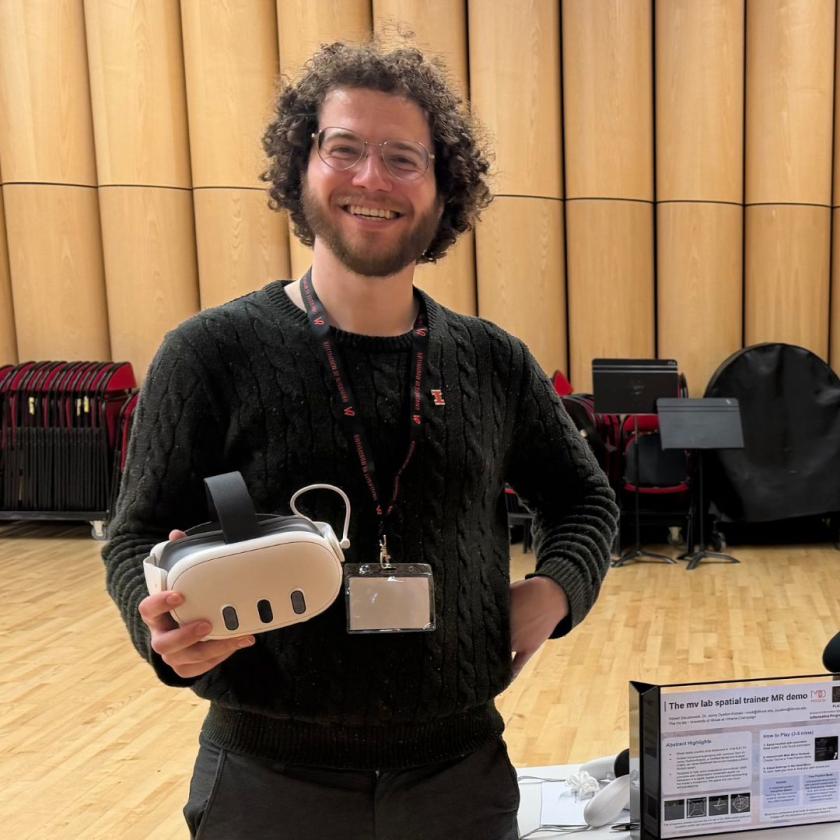
Informatics PhD student Robbie Sieczkowski's project, "The mv lab spatial trainer," is a mixed-reality app designed to help users learn and practice foundational concepts in Laban-Bartenieff Movement Analysis (LBMA).
Developed in collaboration with his advisor, Jenny Oyallon-Koloski, director of the mv lab (Movement Visualization Lab), the app uses a VR headset to see the real world with the app’s environment overlaid on it. The movement analysis framework, developed from the work of choreographer and movement theorist Rudolf Laban, is used to observe, describe, and interpret human movement.
Sieczkowski is now continuing development of the project in Informatics Teaching Assistant Professor Katryna Starks' PLAYlab, where he is incorporating serious game design principles into the experience.
"I am interested in applying my game development skills to applications across any interesting domain," Sieczkowski said. "I found the LBMA subject matter to be a great fit for a serious game project utilizing Mixed Reality technology, where users occupy space in the app while having visuals grounded in real life."
The mv lab spatial trainer is designed for dancers and other "movers" to practice Laban movement scales—structured movement sequences that help users explore how the body moves through space. Similar to musical scales, the repetitive exercises guide users through different spatial dimensions and encourage greater awareness of movement and physical space.
Built using the Unity game engine software, the app features two modes: a "scaffolded tutorial" for users who are new to the concept and a "scale trainer mode" that lets users perform repetitions of fundamental scales such as the dimensional scale.
"Much like musical notation with its symbols and musical meaning, LBMA scales provide a notation system to codify and express the movement of one’s ligaments in all dimensions around them," Sieczkowski said. "It is an important system for movement practitioners who are 200+ hour-certified in LBMA, including professional dancers, yoga instructors, and choreographers. It can also provide structure for less-versed movers to become more thoughtful and comfortable in their daily movements."
Although Sieczkowski does not have a formal dance background, he regularly practices vinyasa yoga, which—in addition to biking, running, and music—has shaped his interest in movement and bodily awareness. The project has helped him explore LBMA as a useful framework for movement and movement education, he said.
Sieczkowski presented his project this spring in Montpellier, France, at the Movement and Computing Conference (MOCO '26)—his first conference experience. There, he connected with international movement scholars interested in teaching applications for the LBMA system.
"I was thrilled to share my work with an international community of academics who are interested in technology applications in movement and beyond," he said.
Sieczkowski hopes to continue expanding the project through future playtesting and collaborations.