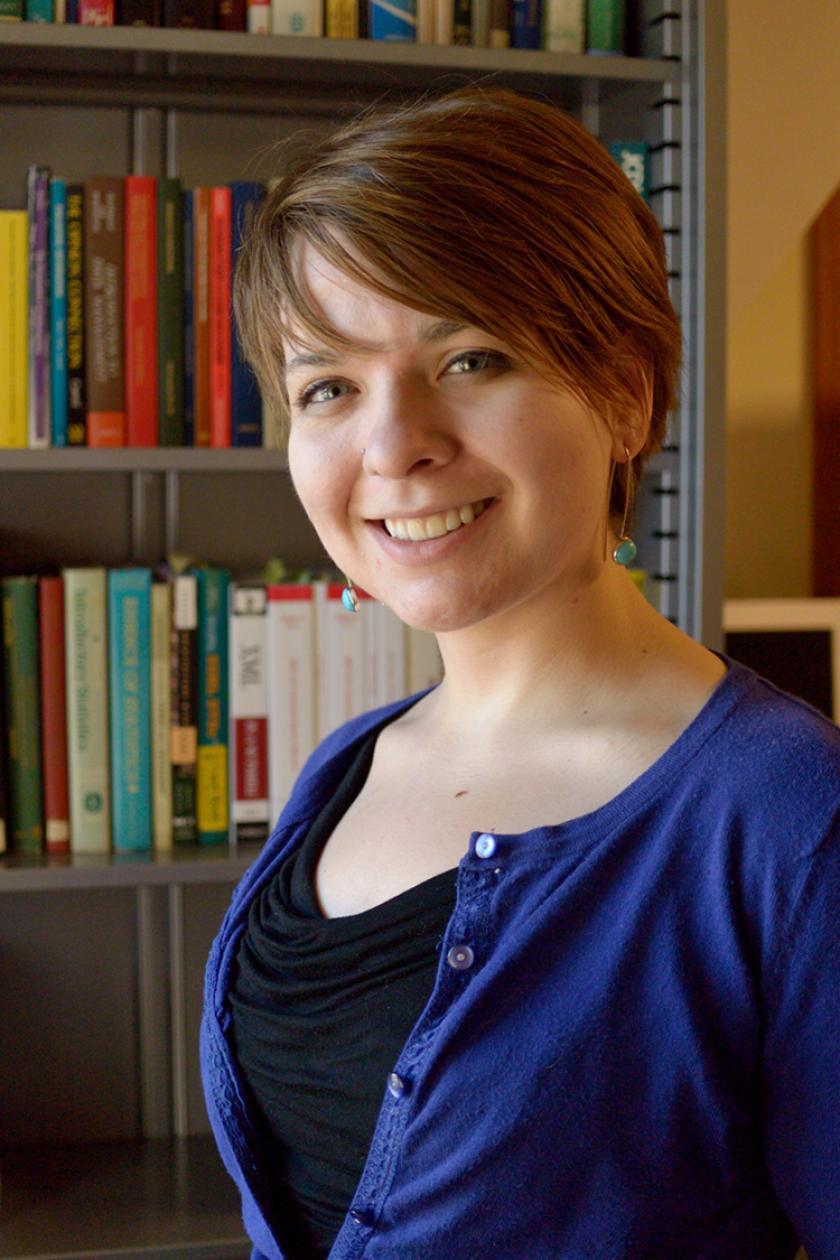
 With a background in the humanities, master's student Elizabeth Surbeck was anxious about using technology and studying information science when she arrived at GSLIS. Now she's about to complete her degree with a specialization in socio-technical data analytics, co-leads the Champaign-Urbana Python Users Group, and is ready to pursue a career as a data analyst.
Why did you decide to pursue an LIS degree?
I decided to pursue an LIS degree because I fell in love with the field while working as a student at Booth Library at Eastern Illinois University. I did everything from archival work to circulation. It was work that made me feel useful, and it was different all the time. I enjoyed it enough that my boss and mentor at the time encouraged me to apply.
Why did you choose GSLIS?
There are many reasons why I wanted to go to GSLIS. The most important reason was that I wanted to go into information science and understand the growing attention towards digital information. GSLIS, as far as I could see, would provide one of the best opportunities to be educated in that area. I also knew people who went here and wanted to be a part of the lively and academically progressive culture at GSLIS.
What particular LIS topics interest you most?
I've found myself particularly devoted to data analytics and hold an interest in the entire data life cycle surrounding it. If I wasn't focusing on data curation or socio-technical data analytics, I would go into community informatics. I love following what that part of GSLIS is doing.
What surprises you about the field of LIS?
I was surprised at first to be taught by so many professors from computer science. I started with a kind of anxiety caused by working with technology, even though I was curious about information science. I bought a Mac originally because its design was user-friendly to me as a humanities student, and I was certain I couldn't break it. Technology lost its mystery, though, after a few classes at GSLIS. Now it excites me.
What do you do outside of class?
When I'm not at GSLIS, I'm usually at Makerspace Urbana, co-running the Python Users Group in Champaign-Urbana, which is known as Py-CU. It is filled with coders of many levels, ages, and backgrounds. We all just happen to program in Python, even if it isn't all we do. My weekends tend to be spent in my skates, refereeing roller derby games for Twin City Roller Derby and nearby leagues. In the off-season, I switch to cycling around Champaign County on my road bike.
What career plans or goals do you have?
I would like to try working in private industry after GSLIS as a data analyst or in a management position where I have a greater view of a company's data cycle. I'm especially interested in the user experience side of the data cycle and helping organizations transition to seeing data as a valuable and useable resource for information and decision-making.