School of Information Sciences

Tilley talks summer reading with U of I News Bureau

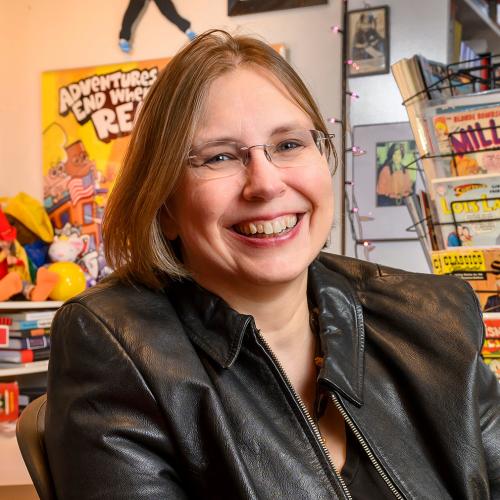
Carol Tilley
Carol Tilley, Associate Professor

GSLIS Assistant Professor Carol Tilley recently spoke with the U of I News Bureau about kids and summer reading. Tilley, a former school librarian and expert on comics and youth services librarianship, spoke with News Bureau news editor Dusty Rhodes. The full interview is available on the campus website.

Parents tend to regard comics as the “candy” of the reading pyramid — treats to be consumed sparingly, and only after reading “real” books. Should parents worry if their kids gravitate toward comics?

My short answer is, no.

For many decades, librarians, teachers, parents and other folks who care about kids and their reading have relied on metaphors that books and reading are like food or ladders or steppingstones. These metaphors are easy but not always accurate ways of thinking about children’s literacy development.

Most contemporary scholars of reading argue – and I concur – that reading is reading, at least in terms of gaining fluency, which is an aspect of reading that involves expression and understanding. Comics, gaming websites, sports pages, text messages, novels and any other kind of reading you can imagine help develop a person’s reading fluency.

Beyond that, it’s important to understand that comics aren’t all funny animals or superheroes – not that either of those genres is bad or suspect. This medium comprises a wide variety of styles, genres and formats that can also help readers of all ages develop empathy, learn new ideas and more.

In a lifetime of reading comics, this medium has challenged me to consider what makes the American political mythos both inspiring and troubling (for example, Mark Millar’s “Superman: Red Son”) and what lies at the heart of friendship (for example, Andy Runton’s “Owly” series). I’ve learned about important events in history (Jim Ottaviani’s “T-Minus: The Race to the Moon”), gained insights into life in little-understood realms (Guy Delisle’s “Pyongyang: A Journey in North Korea”) and relived not-always-pleasant moments from adolescence (Mariko and Jillian Tamaki’s “Skim”). And I’ve been enchanted by the worlds I’ve encountered in comics such as David Petersen’s “Mouse Guard” series, Shaun Tan’s “The Arrival” and Linda Medley’s “Castle Waiting.”

And no, not all of those titles are for kids!

Tags:
Updated on
Backto the news archive

Related News

Chan’s "Predatory Data" named a 2026 PROSE Award finalist

Professor Anita Say Chan's book Predatory Data: Eugenics in Big Tech and Our Fight for an Independent Future (University of California Press, 2025) has been named a finalist in the Computing and Information Sciences Category of the 2026 PROSE Awards. The annual awards bestowed by the Association of American Publishers recognize the very best in professional and scholarly publishing and celebrate works that have made significant advancements in their respective fields of study.

Anita Say Chan

He inducted into Sigma Xi

Professor Jingrui He has been inducted into Sigma Xi, The Scientific Research Honor Society. Sigma Xi is the international honor society of science and engineering and one of the oldest and largest scientific organizations in the world, boasting a history of service to science and society spanning over 125 years. It has a multidisciplinary membership of scientists, engineers, and scholars, and Sigma Xi chapters can be found in universities and colleges, government laboratories, and commercial research centers.

Jingrui He

Hassan and Bashir receive distinguished paper award

A paper co-authored by PhD student Muhammad Hassan and Associate Professor Masooda Bashir received the Distinguished Paper Award at the Workshop on Security and Privacy in Standardized IoT, which was held last month in San Diego, California, in conjunction with the Network and Distributed System Security (NDSS) Symposium 2026. 

iSchool researchers to present work at Technocracy Conference

This week, iSchool PhD students and faculty will present their research at the Technocracy Conference. Hosted by the Unit for Criticism and Interpretive Theory at the University of Illinois on March 5–6, the conference will begin with a panel of graduate student papers and continue the following day with invited speakers and a keynote. All events will take place at the Levis Faculty Center on the Urbana campus. 

New multi-institutional project to use AI to represent past historical periods

A new project led by a team of researchers from four universities aims to create and evaluate language models that represent past historical periods. The project, "Artificial Intelligence for Cultural and Historical Reasoning," was recently selected for a 2025 Humanities and AI Virtual Institute (HAVI) award from Schmidt Sciences. The $800,000 grant will be split among four institutions: Cornell University, the University of Illinois Urbana-Champaign, The University of British Columbia, and McGill University. Professor Ted Underwood will serve as the principal investigator for the portion of the project at Illinois.

Ted Underwood

School of Information Sciences

501 E. Daniel St.

MC-493

Champaign, IL

61820-6211

Voice: (217) 333-3280

Email: ischool@illinois.edu

Back to top